
The Phrasal Verb 'Cut Up' Explained
- Jan 2
- 9 min read
Updated: Feb 22
An explanation of the different meanings of the English phrasal verb 'cut up' from a native speaker, with lots of examples in context

Hello and welcome to my website for English learners all about phrasal verbs where I explain their different meanings to help you understand, learn and use them like a native.
How well do you know the English phrasal verb 'cut up'? In this article, I will be explaining its five different meanings for you, which include some that are used in American English, some in British English and some that are used everywhere in the English-speaking world. In addition, I will provide you with lots of example sentences for each different application of 'cut up' to show you the different ways that each one is normally used by native speakers. So, without further ado, let's get started....
TABLE OF CONTENTS (Click to jump to each one)
I love writing this blog & helping learners but I receive very little feedback as to how useful it is or if people enjoy & learn from it. Therefore, if you find the post useful, please like & share it or leave a comment at the end. I'd be very grateful. Thank you! James 😊 |

THE BASICS
CUT UP: KEY INFORMATION
Usage | Common |
Number of meanings | 5 |
Past tense forms | Cut up / Cut up |
Separable? | Yes |
As per usual on Phrasal Verbs Explained, let's start things off by taking a look at the individual words that form the phrasal verb that I will be explaining, which in the case of 'cut up' are the words 'cut' and 'up'.....
Cut - The irregular verb 'to cut' is one that has a variety of different meanings in English, with perhaps the most common of these being 'to use something sharp to break the surface of something or to separate it from something else'. In addition to this, we can use the verb 'to cut' to mean 'to reduce or stop something', 'to delete something' and also even 'to record music', among other less common meanings.
The grass in the garden is very long; I think I will cut it today.
Sarah has had her hair cut very short.
The local council has cut funding for youth services.
The band cut their new record in a studio in the Scottish Highlands.
Up - The prepositional particle 'up' is the one that is the most common in phrasal verb constructions and can add a variety of different meanings to a phrasal verb, depending on the context. Perhaps most obviously, when 'up' appears in a phrasal verb it can give the idea of an upward movement or an increase (go up), however it can also add such diverse meanings as completion (eat up), preparation (set up), appearance (show up) and ending (break up).
So, now that we have covered the basics, let's take a look at the different meanings of the phrasal verb 'cut up'....
MEANING 1: To cut something into pieces

CEFR Language Level | B1 - Intermediate |
Usage | Common |
Where is it used? | Everywhere |
Potential synonyms | To chop up, to slice up, to cut |
Separable? | Yes |
Our first meaning of the phrasal verb 'cut up' is one that will hopefully be nice and simple for you and means 'to cut something into pieces'.
Nouns commonly used with this application....
|
Did you know that in English, it is perfectly acceptable and correct to say that someone can cut a tree down and then cut the same tree up?! It sounds completely wrong because once you cut a tree down, it is impossible for it to go back up again and of course that is not what we mean when we say this. What we actually mean is that once the tree has been cut down, it is then cut into small pieces or logs.
The word 'up' in the instance above does not refer to an upwards movement but rather it signifies the result of a cutting action and we can therefore use 'cut up' to describe when we cut anything into smaller pieces. This may be a parent cutting up their child's food to make it easier for them to eat or somebody cutting up a piece of paper into smaller pieces to make something out of them.
Note that there is a distinct difference between 'cut' and 'cut up' in this context. If you use 'cut' on its own, it normally refers to one slice or cutting action. In contrast, 'cut up' would mean that the cutting action is repeated until the task is finished and the original item is divided into many pieces.
This application is separable, with the direct object (the item being cut) going either between 'cut' and 'up' or after them with no change in meaning.
My mum cut the vegetables up before adding them to the soup.
Please could you cut up the chicken into bite-sized pieces.
Martin cut up the paper so the kids could use it for crafts.
The chef cut the fruit up and arranged it on a platter.
Would you mind cutting up the meat for the baby?
The carpenters cut up the old carpet to make it easier to remove.
I cut the apples up and put them in the bowl.
The butcher cut up the whole fish for his customer.
MEANING 2: To be physically injured
CEFR Language Level | C1 - Advanced |
Usage | Medium |
Where is it used? | Everywhere |
Potential synonyms | To be cut, to be injured |
Separable? | Yes |
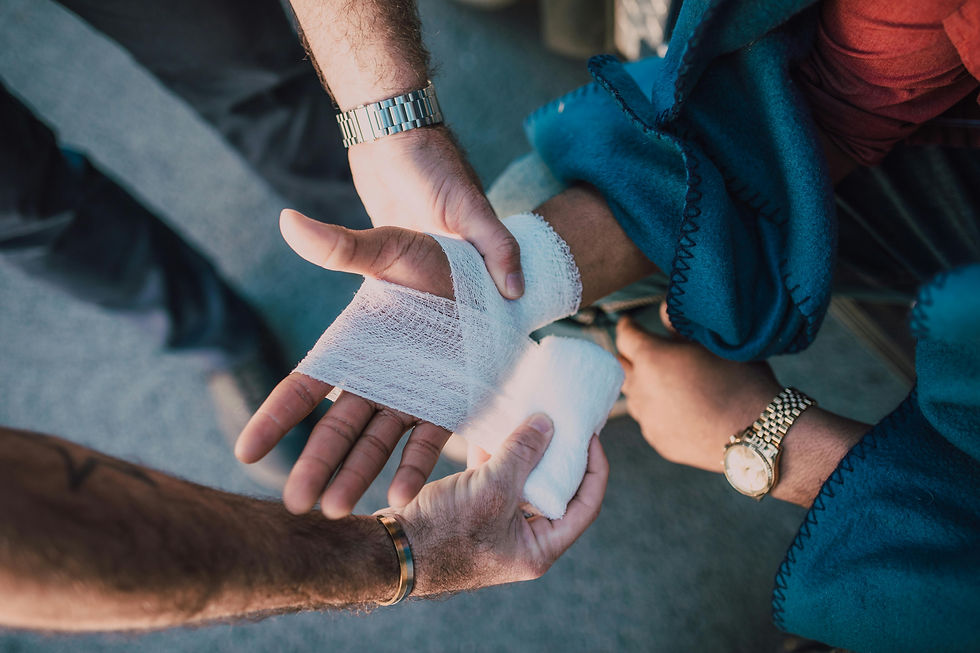
Let's now move onto our second meaning of the phrasal verb 'cut up', which is a painful one as it means 'to be physically injured'.
You may or may not be aware that if you 'cut yourself' in English, it means that you injure yourself in such a way that your skin is broken and you bleed. For example, it is common to cut yourself when shaving or when cutting up food in the kitchen (a nice link back to the previous application there 😉). If you have been unlucky enough to be in a situation in which you sustain several cuts to your body or more, e.g. a fight or a car accident, then you could say that you are "cut up".
Note that we mainly use this application in a passive sense to talk about the result of a painful experience in which a person has been cut many times. It is not typically used in an active sense e.g. you do not cut someone up in this way, as if you do, it will likely be understood to mean cut into small pieces as in the first application.
Sometimes, we add the extra word 'all' to form the expression 'all cut up', to intensify how badly injured a person is.
The little boy fell into the bushes whilst playing and got cut up by the thorns.
Susie's arms were badly cut up after climbing over the fence.
The boxer’s face was all cut up by the end of the fight.
I got cut up when I fell off my bike on the gravel road.
Ben's hands were all cut up from working with broken glass.
Jane came back cut up and bleeding after the accident.
The soldier has been cut up by flying debris.
MEANING 3: To be emotionally upset

CEFR Language Level | C1 - Advanced |
Usage | Medium |
Where is it used? | British English |
Potential synonyms | To be upset, to be distressed |
Separable? | Yes |
For our third application, we are moving from physical pain to mental distress as it means 'to be emotionally upset' and is primarily a British English usage.
Much like with the previous application, for this one we are concerned with the after effects of a negative experience, however this time it is something that makes us sad, emotional or very hurt.
If you are 'cut up' emotionally, then you are mentally distressed in a way that is stronger than being upset and is often heard in reference to people who experience romantic loss and heartache. For example I might be upset if my partner forgets our wedding anniversary but I would be 'cut up' if my partner left me for another person. If we think back to the first application of 'cut up', it is a bit like our inner peace or happiness has been cut into lots of different pieces and is usually used to describe a deep or intense emotional upset.
As with the second application, we also do not usually use this application in an active sense as it tends to be used more as a way of describing the state of a person's emotions following a traumatic experience.
Becci was really cut up about not getting the job.
Alan’s still cut up over the way the relationship ended.
I would be so cut up if I found out that she was cheating on me!
I was pretty cut up when I heard about his terminal illness.
Natasha's parents were deeply cut up after the accident.
John sounded really cut up on the phone after the argument with Jo.
Marcia got very cut up about her crush not texting her back.
MEANING 4: To drive in a dangerous way

CEFR Language Level | C1 - Advanced |
Usage | Common |
Where is it used? | British English |
Potential synonyms | To cut off |
Separable? | Yes |
Our next application of the phrasal verb 'cut up' is another one that is mainly used in British English and means 'to drive in a dangerous way'.
I should state here before we go any further that 'cut up' is not used to talk about dangerous driving in general, but rather it refers to something specific that drivers of vehicles do that is both dangerous and irresponsible.
Have you ever been in a situation when you have been in a car on a dual carriageway or multi-lane freeway, either as a driver or a passenger, and a car driving in front of you in another lane has suddenly moved sideways into your lane so that you have to apply the brakes very quickly to avoid an accident? If so, then you have experienced being 'cut up' by another driver as this is precisely what it is.
To give you a better idea of what cutting up is, check out this video, which shows a classic example of someone doing it...
For those of you who are more familiar with American English, 'cut off' would be the equivalent used instead.
The car suddenly cut me up on the motorway, forcing me to brake hard.
A van cut up the motorcyclist as it changed lanes.
Nicholas was fined for cutting up another driver at the junction.
Don’t cut people up like that; it’s extremely dangerous.
The taxi cut us up just before the roundabout.
Sandra accused the lorry driver of cutting her up in traffic.
Another car cut him up while overtaking, almost causing an accident.
I can't stand it when drivers cut you up without indicating.
MEANING 5: To misbehave

CEFR Language Level | C1 - Advanced |
Usage | Medium |
Where is it used? | American English |
Potential synonyms | To misbehave, to play up, to act up |
Separable? | No |
We now come to our fifth and final application of the phrasal verb 'cut up' for this one we are going to switch to the other side of the Atlantic Ocean as this one is an American usage that means 'to misbehave'.
To clarify, what I mean by 'to misbehave' is to act or behave in an unacceptable way, often by breaking rules. Specifically, when someone 'cuts up', it means that they misbehave, usually by being silly, noisy or disruptive in order to attract attention to themselves or make others laugh. As you can imagine, it is often used to refer to naughty and excited school children when they are not listening and preventing their teacher from teaching them. Typically, this usage implies harmless behaviour, which is annoying for those who have to deal with it.
Unlike many of the other applications we have looked at, this usage is not separable and does not take a direct object.
Some of the kids were cutting up in the back of the classroom.
Joseph kept cutting up during the meeting and couldn’t stay serious.
If you don’t stop cutting up, you’ll be sent out of the room.
The boys were just cutting up and laughing instead of doing their work.
Taylor was cutting up at lunch with her friends Mary-Sue and Keisha.
The audience started cutting up when the comedian forgot his jokes.
They've been cutting up all afternoon instead of practising.
Stop cutting up and pay attention to what I am saying!

We have now reached the end of this post and I just want to say thank you for clicking on my post and reading it. I hope that you've enjoyed it and have been able to learn something new about the phrasal verb 'cut up'. If you enjoyed this post, please go ahead and check out some of my other posts.
Now it is YOUR turn. Can you think of a sentence yourself using 'cut up'. Write it in the comments section below if you can, or alternatively any comments, suggestions or feedback that you may have....don't be shy!!!
Sign up on the form below if you want to receive new blog posts directly by email every week as soon as they are published.
Also, if you found the post useful, please like and share it on social media. See you next time! James 😊
THE END


Comments